
Conveyor belt
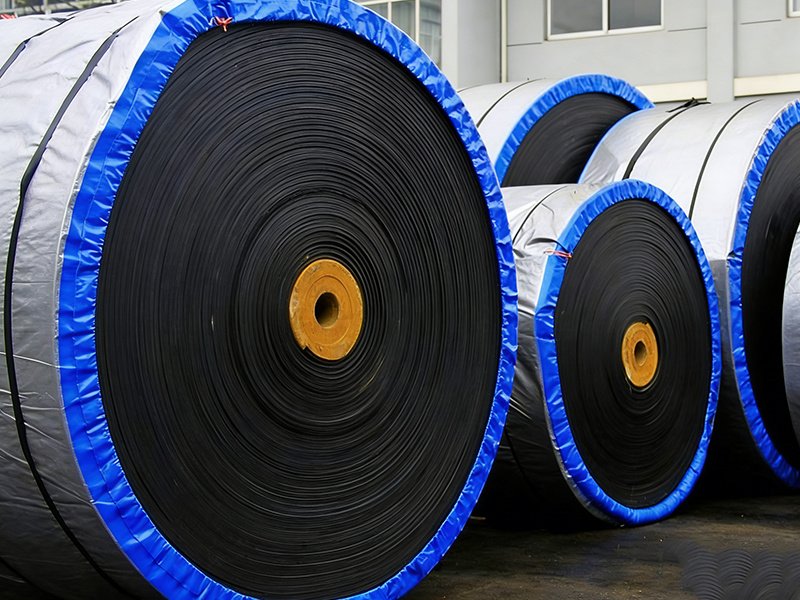
Conveyor belt
Nylon-rubber conveyor belts are particularly well suited for applications in mining—such as crushing and screening of ore, sand washing, port terminals, power generation, metallurgy, chemical processing, coal handling, steelmaking, cement production, and construction—where they reliably convey materials over most medium- to long-distance routes under high-load and high-speed conditions.
Conveyor belt
Uses
Nylon-rubber conveyor belts are particularly well suited for applications in mining—such as crushing and screening of ore, sand washing, port terminals, power generation, metallurgy, chemical processing, coal handling, steelmaking, cement production, and construction—where they reliably convey materials over most medium- to long-distance routes under high-load and high-speed conditions.
Characteristics
Compared with other types of conveyor belts, nylon conveyor belts:
• High strength: The belt features a high-strength nylon fabric carcass, offering excellent tensile strength to withstand heavy-load transportation and substantial tensile stress, making it ideal for conveying high-capacity materials.
• Impact resistance: The belt material exhibits excellent elasticity, effectively absorbing and withstanding impacts from the conveyed materials, thereby reducing damage caused by impact. This advantage is particularly pronounced when conveying bulk and granular materials.
• Excellent wear resistance: Outstanding resistance to wear under prolonged, high-speed conditions, extending service life, reducing replacement frequency, and lowering maintenance costs.
• Resistance to deformation: Nylon conveyor belts exhibit a low degree of deformation, remaining dimensionally stable even under prolonged, high-frequency operation and maintaining excellent flatness.
Strong adaptability to industrial environments:
• Excellent flexibility: easy to form troughs, adaptable to various conveying equipment and routing configurations, and capable of operating reliably under complex conditions such as bending and inclining.
• Secure Joints: The joint design is flexible and versatile, allowing for the selection of an appropriate connection method based on different operating environments. Moreover, the joints are robust and reliable, resistant to cracking or breakage, thereby ensuring the safe conveyance of materials.
Good chemical stability:
• Corrosion resistance: Exhibits excellent resistance to acids, alkalis, salts, and chemical agents, enabling reliable operation in corrosive environments such as chemical plants and mining sites.
• Mold and corrosion resistance: Nylon material is inherently resistant to mold and corrosion, maintaining excellent performance even in humid environments and thereby extending the service life of conveyor belts.
Other features:
• High-temperature resistance: Capable of long-term operation in high-temperature environments, with temperature resistance exceeding 200°C, making it suitable for high-temperature applications in industries such as ceramics, steel, and cement.
• Lightweight: Compared with conveyor belts made from other materials, nylon conveyor belts are lighter in weight, making installation and maintenance more convenient while also reducing the load on the conveying equipment.
• Fatigue resistance: Excellent fatigue performance enables the conveyor belt to withstand prolonged, high-frequency bending and vibration, ensuring stable operation over long service life.
Nylon conveyor belts made from SBR, NBR, or EPDM rubber, featuring high tensile strength and exceptional resistance to abrasion, oil, heat, and wear. These multi-ply fabric belts can be manufactured as smooth nylon belts or as patterned nylon belts. Available in fire-resistant, cold-abrasion-resistant, heat-resistant, acid- and alkali-resistant, oil-resistant, and static-dissipative versions, among others.
Application Fields
Our nylon fabric conveyor belts are ideal for conveying bulk, high-density materials of large, medium, and small sizes, such as minerals and coal. They are particularly well suited for operation in harsh environments that demand relatively high belt dimensional stability. These belts are widely used in industries including mining, fertilizer production, power generation, cement manufacturing, steelmaking, metallurgy, coal handling, grain processing, chemical manufacturing, port operations, and construction, and are capable of efficiently conveying materials over short, medium, and long distances under high-load, high-speed conditions.
Specifications and Technical Data
| Fabric Type | Fabric Structure | Fabric specifications | Thickness | Strength (N/mm) | Covering thickness | Width | Length | |||||
| path | latitude | mm/ply | 2ply | 3Ply | 4ply | 5ply | Up | down | mm | m | ||
Nylon | Post | Polyamine | Nylon/80 | 0.95 | 160 | 240 | 320 | 400 |
1.5-12 |
0-4.5 | 400-2500 | 50-500 |
| Nylon/100 | 1 | 200 | 300 | 400 | 500 | |||||||
| Nylon/150 | 1.1 | 300 | 450 | 600 | 750 | |||||||
| Nylon/200 | 1.2 | 400 | 600 | 800 | 1000 | 500-2500 | ||||||
| Nylon/250 | 1.35 | 500 | 7500 | 1000 | 1250 | |||||||
| Nylon/300 | 1.45 | 600 | 900 | 1200 | 1500 | |||||||
| Nylon/350 | 1.6 | – | 1050 | 1400 | 1750 | 800-2500 | ||||||
| Nylon/400 | 1.75 | – | – | 1600 | 2000 | 1000-2500 | ||||||
| Nylon/500 | 1.9 | – | – | 2000 | 2500 | |||||||
| Nylon/630 | 2.1 | – | – | 2400 | 3000 | |||||||
Adhesion and elongation of conveyor belts
| Adhesive force | elongation | |||
| Between plies (N/mm) | Between the rubbers | Longitudinal elongation at %≥ | Longitudinal elongation at 6% of the reference load | |
| Nylon conveyor belt | ≥5 | ≥5 | 10 | 2 |
Quality/Grade Standard Performance Parameters for Cover Adhesive
| Coverage Level | Tensile strength | elongation | Wear | Tensile Strength and Elongation at Break After Aging | Standard |
| greater than or equal to | greater than or equal to | less than or equal to | |||
| MPA | % | MM3 | % | ||
| m | 24 | 450 | 125 | -50 | Australian Standard AS1332-2000C |
| n | 17 | 400 | 200 | -50 | |
| RMA1 | 17 | 400 | 175 | -50 | American standard |
| RIMA2 | 14 | 350 | 250 | -50 | |
| z | 15 | 350 | 250 | -50 | German standard DIN 22102 |
| y | 20 | 400 | 150 | -50 | |
| x | 25 | 400 | 120 | -50 | |
| w | 18 | 400 | 90 | -50 | |
| c | 10 | 150 | 200 | -50 | Russian standard |
| n | 15 | 400 | 100 | -50 | |
| T2 | 14.7 | 300 | 200 | -50 | |
| m | 14.7 | 350 | 150 | -50 |
| Product Series | Layered Fabric-Core Conveyor Belt |
|---|---|
| Applications | Our nylon fabric conveyor belts are ideal for conveying bulk, high-density materials of large, medium, and small sizes, such as minerals and coal. They are particularly well suited for operation in harsh environments that demand relatively high belt dimensional stability. These belts are widely used in industries inclu… |
| Key Advantages | Compared with other types of conveyor belts, nylon conveyor belts: • High strength: The belt features a high-strength nylon fabric carcass, offering excellent tensile strength to withstand heavy-load transportation and substantial tensile stress, making it ideal for conveying high-capacity materials. • Impact resistanc… |
| Customization | OEM / ODM, drawing-based production, factory-direct supply and engineering support |
| Source Product ID | Yilin original product 2 |
Product support for OEM & ODM
Drawing-based production, sample confirmation, and custom orders are supported from design to delivery.
Strong production capabilities
Conveyor belts, idlers, rollers, drums, supports, frames, and accessories can be manufactured for industrial projects.
Product quality assurance
Production inspection, packaging checks, and shipment coordination help keep product quality stable.
After-sales support
Our team supports product selection, technical communication, delivery tracking, and after-sales response.
Can I place a small batch order?
Yes. Small batch orders and sample confirmation can be arranged according to the product model and production schedule.
Do you have a pre-shipment inspection procedure?
Yes. Size, appearance, packaging, and key performance items can be checked before shipment.
Can samples be sent before bulk orders?
Yes. Samples can be arranged for testing or confirmation when the product specification is clear.
What information is needed for quotation?
Please send the product model, drawings, quantity, operating conditions, and expected delivery time.
Can you customize products from drawings?
Yes. OEM, ODM, and drawing-based customization are available for conveyor equipment and components.
What is the delivery time?
Delivery time depends on product model, quantity, and customization requirements. Standard products can usually be arranged faster.
Keywords: Layered Fabric-Core Conveyor Belt